Insuranceciooutlook

Insurance CIO Outlook

Cogitate
Turning Insurance Complexity into Operational Clarity

Follow Cogitate on :

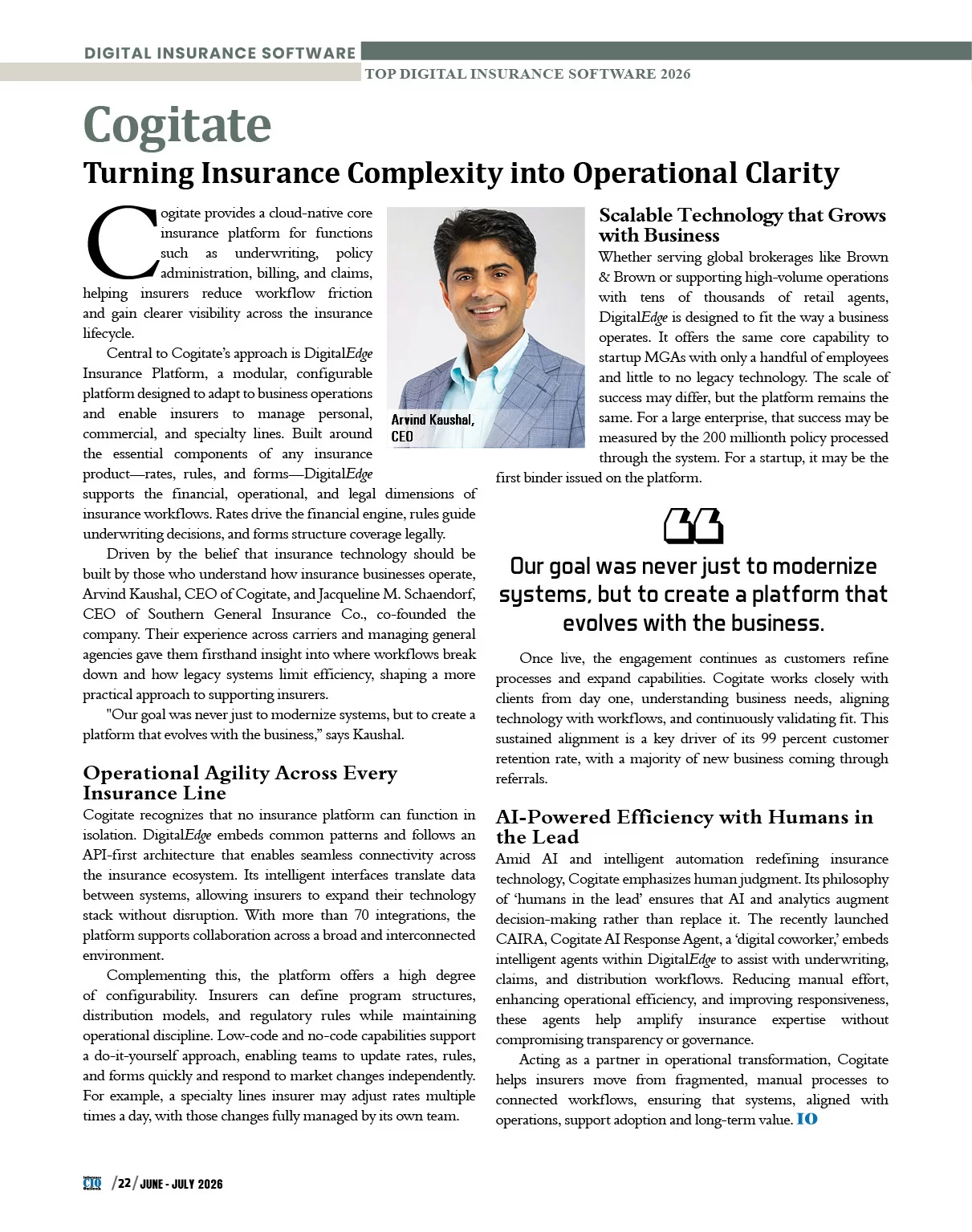
Arvind Kaushal, Cogitate | Insurance CIO Outlook | Top Digital Insurance SoftwareArvind Kaushal, CEO
What role does Cogitate play in simplifying insurance operations across lifecycle functions?

Cogitate provides a cloud-native core insurance platform for functions such as underwriting, policy administration, billing, and claims, helping insurers reduce workflow friction and gain clearer visibility across the insurance lifecycle.

Central to Cogitate’s approach is DigitalEdge Insurance Platform, a modular, configurable platform designed to adapt to business operations and enable insurers to manage personal, commercial, and specialty lines. Built around the essential components of any insurance product—rates, rules, and forms—DigitalEdge supports the financial, operational, and legal dimensions of insurance workflows. Rates drive the financial engine, rules guide underwriting decisions, and forms structure coverage legally.

Driven by the belief that insurance technology should be built by those who understand how insurance businesses operate, Arvind Kaushal, CEO of Cogitate, and Jacqueline M. Schaendorf, CEO of Southern General Insurance Co., co-founded the company. Their experience across carriers and managing general agencies gave them firsthand insight into where workflows break down and how legacy systems limit efficiency, shaping a more practical approach to supporting insurers.

"Our goal was never just to modernize systems, but to create a platform that evolves with the business,” says Kaushal.

Operational Agility Across Every Insurance Line

How does DigitalEdge enable connectivity and configurability across diverse insurance technology ecosystems?

Cogitate recognizes that no insurance platform can function in isolation. DigitalEdge embeds common patterns and follows an API-first architecture that enables seamless connectivity across the insurance ecosystem. Its intelligent interfaces translate data between systems, allowing insurers to expand their technology stack without disruption. With more than 70 integrations, the platform supports collaboration across a broad and interconnected environment.

Complementing this, the platform offers a high degree of configurability. Insurers can define program structures, distribution models, and regulatory rules while maintaining operational discipline. Low-code and no-code capabilities support a do-it-yourself approach, enabling teams to update rates, rules, and forms quickly and respond to market changes independently. For example, a specialty lines insurer may adjust rates multiple times a day, with those changes fully managed by its own team.
  • Our goal was never just to modernize systems, but to create a platform that evolves with the business.


Scalable Technology that Grows with Business

Why is scalability important for supporting both large enterprises and startup insurance organizations effectively?

Whether serving global brokerages like Brown & Brown or supporting high-volume operations with tens of thousands of retail agents, DigitalEdge is designed to fit the way a business operates. It offers the same core capability to startup MGAs with only a handful of employees and little to no legacy technology. The scale of success may differ, but the platform remains the same. For a large enterprise, that success may be measured by the 200 millionth policy processed through the system. For a startup, it may be the first binder issued on the platform.

Once live, the engagement continues as customers refine processes and expand capabilities. Cogitate works closely with clients from day one, understanding business needs, aligning technology with workflows, and continuously validating fit. This sustained alignment is a key driver of its 99 percent customer retention rate, with a majority of new business coming through referrals.

AI-Powered Efficiency with Humans in the Lead

In what way does Cogitate integrate AI while maintaining human oversight in decision-making processes?

Amid AI and intelligent automation redefining insurance technology, Cogitate emphasizes human judgment. Its philosophy of ‘humans in the lead’ ensures that AI and analytics augment decision-making rather than replace it. The recently launched CAIRA, Cogitate AI Response Agent, a ‘digital coworker,’ embeds intelligent agents within DigitalEdge to assist with underwriting, claims, and distribution workflows. Reducing manual effort, enhancing operational efficiency, and improving responsiveness, these agents help amplify insurance expertise without compromising transparency or governance.

Acting as a partner in operational transformation, Cogitate helps insurers move from fragmented, manual processes to connected workflows, ensuring that systems, aligned with operations, support adoption and long-term value.

Deep Dive

Choosing Digital Insurance Software that Aligns Technology with Insurance Expertise

Insurance organizations face mounting pressure to modernize technology while maintaining the precision and regulatory discipline the industry demands. Many carriers, managing general agents and program administrators still rely on legacy systems built decades ago. Those platforms struggle to support product innovation, fast regulatory changes and increasingly complex distribution ecosystems. Technology decisions therefore carry strategic consequences. Leadership teams evaluating digital insurance platforms must focus less on feature volume and more on whether a system genuinely supports how insurance businesses operate. A central concern lies in how technology handles the core mechanics of insurance products. Insurance operations constantly evolve through changes in pricing structures, underwriting rules and policy documentation. Systems that require heavy engineering work to update these components slow down product innovation and limit responsiveness to market shifts. Modern platforms must give insurance teams the ability to adjust rates, modify rules and update forms without prolonged development cycles. Flexibility in these elements determines how effectively insurers launch products, refine underwriting appetite and respond to regulatory changes. Alignment with real insurance workflows also determines whether technology succeeds after implementation. Underwriting teams, brokers, agents and policy administrators collaborate across multiple stages of the policy lifecycle. Systems must support submission intake, underwriting review, quoting, binding, servicing and claims visibility without creating friction between participants. Platforms designed around real operational workflows create transparency across these activities, allowing internal and external stakeholders to collaborate while maintaining oversight of policy performance. Insurance organizations that prioritize this workflow clarity often see faster adoption because the technology mirrors how teams already work. Technology ecosystems further complicate the selection process. No modern insurance platform functions independently. Insurers rely on rating engines, data providers, regulatory services, claims processors and distribution platforms. Software must therefore support stable integration with a broad network of partners. API-driven architecture plays a decisive role because it allows insurers to integrate specialized services without replacing their entire technology stack. Platforms that facilitate these integrations allow companies to expand capabilities gradually rather than commit to rigid technology environments. Human expertise remains equally important as insurers adopt analytics and automation. Data tools increasingly assist underwriting decisions, claims analysis and operational management. Successful platforms treat these capabilities as decision support rather than replacements for insurance judgment. Systems that combine automation with clear oversight allow professionals to process submissions faster while retaining the expertise that governs underwriting quality. Technology that enhances decision-making rather than replacing it creates stronger trust within organizations and leads to more consistent adoption across departments. Cogitate reflects these priorities through its DigitalEdge platform, developed by founders with extensive insurance industry experience. The platform centers on the core elements of insurance products—rates, rules and forms—allowing insurers to adjust these components through configurable tools instead of through engineering cycles. DigitalEdge also supports the full policy lifecycle, enabling collaboration between underwriters, agents and administrators while maintaining transparency across operations. Its API-first architecture enables integration with dozens of ecosystem partners, giving insurers flexibility to evolve their technology environment. Artificial intelligence capabilities, including Cogitate’s CAIRA response agents, assist underwriting, claims and workflow analysis while keeping human decision-makers in control. This balance of insurance expertise, adaptable architecture and ecosystem connectivity positions Cogitate as a compelling choice for organizations pursuing modern digital insurance platforms. ....Read more
Top Digital Insurance Software 2026

Company
Cogitate

Management
Arvind Kaushal, CEO

Description
Cogitate delivers insurance technology shaped by deep industry experience. Its flagship platform, DigitalEdge Insurance Platform is designed to fit insurance workflows rather than force them to change. Cogitate helps insurers streamline underwriting, claims, billing, and distribution across personal, commercial, and specialty lines through modular design, low-code configurability, and AI-driven tools.