
THANK YOU FOR SUBSCRIBING

Insurance CIO Outlook Weekly Brief
Be first to read the latest tech news, Industry Leader's Insights, and CIO interviews of medium and large enterprises exclusively from Insurance CIO Outlook


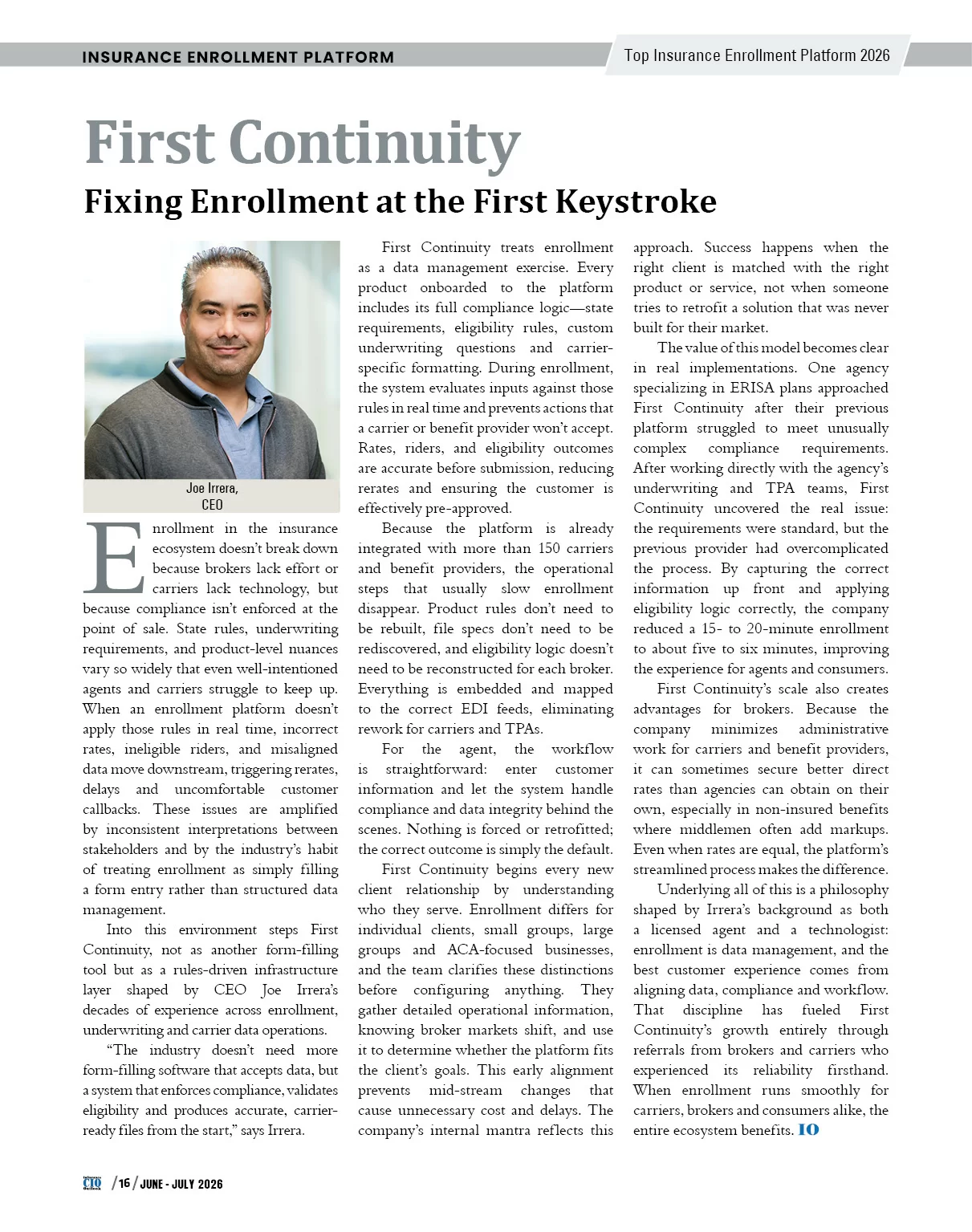
 Joe Irrera, CEO
Enrollment in the insurance ecosystem doesn’t break down because brokers lack effort or carriers lack technology, but because compliance isn’t enforced at the point of sale. State rules, underwriting requirements, and product-level nuances vary so widely that even well-intentioned agents and carriers struggle to keep up. When an enrollment platform doesn’t apply those rules in real time, incorrect rates, ineligible riders, and misaligned data move downstream, triggering rerates, delays and uncomfortable customer callbacks. These issues are amplified by inconsistent interpretations between stakeholders and by the industry’s habit of treating enrollment as simply filling a form entry rather than structured data management.
Into this environment steps First Continuity, not as another form-filling tool but as a rules-driven infrastructure layer shaped by CEO Joe Irrera’s decades of experience across enrollment, underwriting and carrier data operations.
“The industry doesn’t need more form-filling software that accepts data, but a system that enforces compliance, validates eligibility and produces accurate, carrier-ready files from the start,” says Irrera.
How does real-time compliance enforcement improve accuracy during the enrollment process workflow?
First Continuity treats enrollment as a data management exercise. Every product onboarded to the platform includes its full compliance logic—state requirements, eligibility rules, custom underwriting questions and carrier-specific formatting. During enrollment, the system evaluates inputs against those rules in real time and prevents actions that a carrier or benefit provider won’t accept. Rates, riders, and eligibility outcomes are accurate before submission, reducing rerates and ensuring the customer is effectively pre-approved.
For the agent, the workflow is straightforward: enter customer information and let the system handle compliance and data integrity behind the scenes. Nothing is forced or retrofitted; the correct outcome is simply the default.
Why is early client alignment important when configuring enrollment solutions for different markets?
First Continuity begins every new client relationship by understanding who they serve. Enrollment differs for individual clients, small groups, large groups and ACA-focused businesses, and the team clarifies these distinctions before configuring anything. They gather detailed operational information, knowing broker markets shift, and use it to determine whether the platform fits the client’s goals. This early alignment prevents mid-stream changes that cause unnecessary cost and delays. The company’s internal mantra reflects this approach. Success happens when the right client is matched with the right product or service, not when someone tries to retrofit a solution that was never built for their market.
The value of this model becomes clear in real implementations. One agency specializing in ERISA plans approached First Continuity after their previous platform struggled to meet unusually complex compliance requirements. After working directly with the agency’s underwriting and TPA teams, First Continuity uncovered the real issue: the requirements were standard, but the previous provider had overcomplicated the process. By capturing the correct information up front and applying eligibility logic correctly, the company reduced a 15- to 20-minute enrollment to about five to six minutes, improving the experience for agents and consumers.
In what way does platform scale influence pricing and operational efficiency for brokers?
First Continuity’s scale also creates advantages for brokers. Because the company minimizes administrative work for carriers and benefit providers, it can sometimes secure better direct rates than agencies can obtain on their own, especially in non-insured benefits where middlemen often add markups. Even when rates are equal, the platform’s streamlined process makes the difference.
Underlying all of this is a philosophy shaped by Irrera’s background as both a licensed agent and a technologist: enrollment is data management, and the best customer experience comes from aligning data, compliance and workflow. That discipline has fueled First Continuity’s growth entirely through referrals from brokers and carriers who experienced its reliability firsthand. When enrollment runs smoothly for carriers, brokers and consumers alike, the entire ecosystem benefits.
What Are Insurance Enrollment Platforms?
Insurance Enrollment Platforms are digital systems that structure application intake, eligibility checks, product selection, compliance review, payment handling and data delivery across the insurance enrollment lifecycle. Rather than functioning as simple forms, they help organizations manage rules, required disclosures, plan details and downstream file needs in one controlled workflow. The goal is to reduce avoidable rework, improve data accuracy and make enrollment easier for users while keeping submissions aligned with carrier and benefit-provider requirements.
How Does First Continuity Support Insurance Enrollment Platforms?
First Continuity supports Insurance Enrollment Platforms through a rules-driven model that treats enrollment as structured data management. Its platform embeds state requirements, eligibility rules, custom underwriting questions and carrier-specific formatting into the workflow. During enrollment, inputs are evaluated in real time so incorrect rates, ineligible riders or unacceptable submissions can be stopped before they move downstream. The company also connects with more than 150 carriers and benefit providers, helping produce carrier-ready files and mapped EDI feeds.
Why Does Real-Time Compliance Matter During Enrollment?
Real-time compliance matters because enrollment errors often begin at the first point of data entry. Insurance Enrollment Platforms that apply eligibility logic, underwriting requirements and product rules immediately can prevent issues that later become rerates, delays, corrections or customer callbacks. This is especially important when state rules, benefit options and carrier requirements differ across products. By enforcing requirements early, the platform makes accuracy part of the normal workflow rather than a manual review step.
What Capabilities Should Organizations Look for in Enrollment Technology?
Organizations evaluating enrollment technology should look for secure access, guided data capture, eligibility validation, product-rule management, payment support, reporting and reliable data exchange. Insurance Enrollment Platforms also need to support multiple benefit plans or policies without forcing users to repeat the same information across separate systems. Practical value comes from connecting enrollment with billing, commissions, compliance and file delivery, so the information collected at the start remains usable throughout the administrative process and easier to audit as volumes grow or product rules change.
How Does First Continuity Connect Enrollment with Broader Operations?
First Continuity connects Insurance Enrollment Platforms with broader operations by combining enrollment, eligibility, underwriting compliance, merchant processing, billing and commissions in a single turnkey environment. The platform also includes HIPAA-compliant online benefits enrollment, PCI-compliant checkout, electronic signatures for ACH and card processing, list-bill invoicing and real-time tracking of payments, agent sales, commissions and vendor payables. This gives organizations one operating layer for managing enrollment activity and related administrative steps.
How Can Better Enrollment Infrastructure Improve Insurance Outcomes?
Better enrollment infrastructure improves outcomes by turning scattered intake, compliance and data-transfer tasks into a more predictable process. Insurance Enrollment Platforms can reduce duplicate entry, strengthen eligibility coordination, support secure information handling and create cleaner downstream records for carriers, benefit providers and administrators. When rules are embedded into the workflow and data is formatted correctly from the start, teams spend less time correcting submissions and more time maintaining continuity across coverage, billing, service and reporting.
Company
First Continuity
Management
Joe Irrera, CEO
Description
First Continuity is an enrollment technology and services company that embeds compliance, carrier rules, and data validation directly into the enrollment workflow. With integrations across 150+ carriers and providers, it delivers clean submissions, fast activation, and unified support for brokers, carriers, and consumers seeking accurate, predictable insurance enrollment.